AI SaaS Product Classification Criteria
AI SaaS Product Classification Criteria help explain how an AI-powered software solution is grouped, evaluated, and positioned in the market. These criteria focus on the product’s business function, the type of AI technology it uses, and the specific users or industries it serves. They also look at the level of automation the product provides and the real problems or use cases it solves, making it easier to understand the product’s purpose.
Another important part of classification is integration capability how well the product connects with APIs, CRMs, ERPs, or other external systems. Scalability potential, pricing and subscription models, and security and compliance standards help determine whether the product can grow reliably and remain secure over time. Finally, performance and reliability indicators such as uptime, speed, and AI accuracy ensure that the product consistently delivers strong, dependable results in different environments.
What is an AI SaaS Products?
An AI SaaS product is a software application delivered through the cloud that uses Artificial Intelligence to perform tasks, automate processes, or solve specific problems. Instead of installing the software on a computer, users access it online through a subscription model.
In simple words, it is AI-powered software available as a service you pay monthly or yearly, and the company provides continuous updates, storage, and AI features without requiring any setup on your side
Core AI Technologies Behind SaaS Intelligence
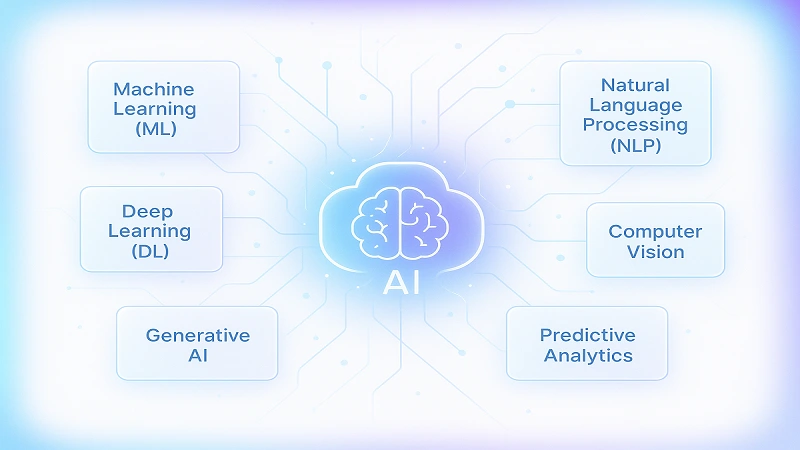
- Machine Learning (ML): Enables predictive analytics, customer segmentation, and fraud detection.
- Deep Learning (DL): Supports advanced use cases such as voice recognition and image classification.
- Natural Language Processing (NLP): Powers chatbots, translators, and intelligent assistants.
- Computer Vision: Used in healthcare imaging, manufacturing inspection, and retail analytics.
- Generative AI: Creates text, designs, and visual content.
- Predictive Analytics: Forecasts sales, churn, or inventory trends.
Example:
- ChatGPT (AI chatbot & content generation)
- Grammarly (AI writing and grammar correction)
- Jasper (AI marketing & content creation)
- Google Gemini (AI assistant across apps)
Core AI SaaS Product Classification Criteria
Core AI SaaS Product Classification Criteria provide a clear framework for understanding how an AI-powered software solution is defined, categorized, and positioned in the market.
1. Business Function
When we classify an AI SaaS product, the first thing we look at is what work or purpose it is made for. Every AI tool is designed to help with a specific type of task inside a business. So understanding its main function makes it easier to know where the product fits and how it helps an organization.
The first step in classifying an AI SaaS product is identifying the business function it supports. AI tools can help different departments, such as:
- Productivity and workflow management
- Marketing and advertising
- Sales automation
- Customer support
- Human resources
- Finance and accounting
- Cybersecurity
- Data analytics
Knowing the business function clearly shows the product’s role and which problems it is designed to solve inside a company.
2. Type of AI Technology Used
Understanding what kind of AI technology a SaaS product uses is an important part of classifying it. Different AI tools work in different ways, so knowing the technology helps us understand how the product thinks, learns, or makes decisions. It also shows how advanced and capable the product is.
AI SaaS products use different types of technologies based on what they are designed to do. Some common AI types include:
• Machine Learning (ML): helps the system learn from data and find patterns
• Generative AI: creates text, images, or other content
• Natural Language Processing (NLP): understands and responds to human language
• Computer Vision: reads and analyzes images or videos
• Predictive Analytics: predicts future trends or outcomes
• Recommendation Systems: give personalized suggestions
This point simply explains the “brain” behind the product and how smart or complex its technology really is.
3. Target User or Industry
Sometimes an AI SaaS product is designed for a specific type of user or a particular industry. Knowing who the product is made for makes it easier to understand its purpose. It also helps us see whether the tool matches the needs of the people who will use it.
The target user or industry tells us which group the AI product is meant to help. It may be designed for:
• Small and medium businesses
• Large companies
• Developers and IT experts
• Hospitals and healthcare workers
• Schools, colleges, and universities
• Online shopping platforms (e-commerce)
• Real estate businesses
• Factories, manufacturing, and supply chain companies
This classification shows how well the product fits the needs, problems, and goals of its main users.
4. Level of Automation
When we study an AI SaaS product, it is also important to see how much work it can do on its own. Some tools only help a little, while others can complete tasks without any human effort. This helps us understand how powerful and time-saving the product really is.
The level of automation shows how independently the AI product can work. It can be:
• AI-Assisted: You do the work, and the AI gives support or suggestions.
• Semi-Automated: The AI handles some parts, but you still need to manage a few steps.
• Fully Automated: The AI does almost everything with very little human involvement.
Higher automation means the tool can save more time, reduce effort, and make work faster.
5. Use Case or Problem Solved
When we classify an AI SaaS product, we also look at what exact problem it is made to solve. Every AI tool is built for a clear purpose, and knowing this purpose helps us understand why the product exists and how it can be useful in real life.
The use case or problem solved shows what the AI actually helps with. It can be:
• Content creation
• Customer service
• Data analysis
• Fraud detection
• Decision-making
• Process optimization
By knowing the problem it solves, we can clearly see the product’s main purpose and how valuable it is for users.
6. Integration Capability
When we classify an AI SaaS product, we also check how well it can connect with other tools or software. This matters because businesses use many systems, and the AI product should work smoothly with them.
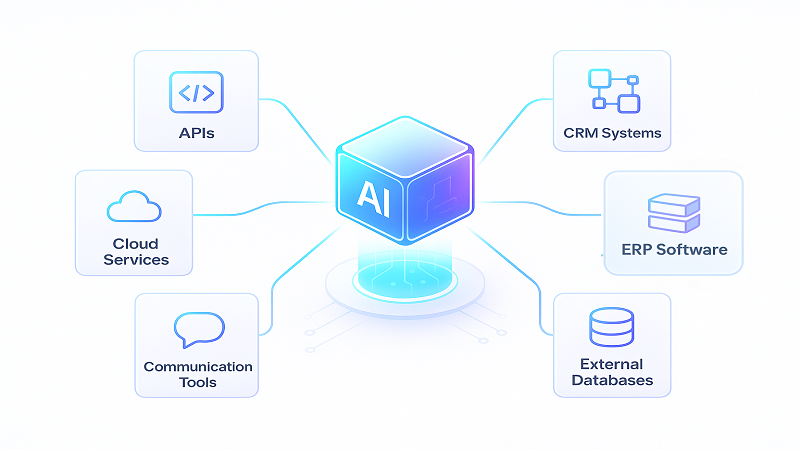
The integration capability shows how easily the AI tool can connect with:
• APIs
• CRM systems
• ERP software
• Cloud services
• Communication tools
• External databases or platforms
Better integration makes the product easier to use and helps more people or companies adopt it without problems.
7. Scalability Potential
As an AI SaaS product becomes more popular, it should be able to grow without breaking or slowing down. This ability to grow smoothly is called scalability, and it helps the software support bigger tasks as a business expands.
Scalability shows whether the software can:
• Handle more and more data
• Support additional users without getting slow
• Deliver strong, enterprise-level performance
• Remain stable over a long period of time
A scalable AI SaaS product continues to work well even as needs increase, making it reliable for future growth.
8. Pricing and Subscription Model
Every AI SaaS product comes with its own way of charging users. Understanding the pricing structure helps people choose a plan that fits their budget and needs. It also shows how flexible and affordable the product is for long-term use.
Pricing structure is another important classification factor. Common models include:
• Freemium (free version with paid upgrades)
• Tiered pricing plans (different levels for different needs)
• Usage-based billing (pay only for what you use)
• Enterprise custom pricing (large organizations get personalized plans)
This helps customers understand affordability, flexibility, and long-term cost commitment.
9. Security & Compliance
Security is one of the most important parts of any AI SaaS product. Since these tools often handle private or sensitive information, they must keep user data safe. Good security builds trust and helps the product meet legal requirements.
Security & compliance include:
• Data encryption (protecting data so others can’t read it)
• User access control (only the right people can access the system)
• GDPR, HIPAA, or industry-specific compliance (following important laws and rules)
• Secure hosting and storage standards (safe servers and cloud systems)
Strong security ensures the product is trustworthy, reliable, and legally safe to use.
10. Performance & Reliability
Performance and reliability show how well an AI SaaS product works on a daily basis. Users expect the software to run smoothly, respond quickly, and give correct results. A strong product performs well even when many people are using it at the same time.
Performance & reliability include:
• High uptime (the software stays online without issues)
• Fast response speeds (it works quickly)
• Low error rates (very few mistakes or failures)
• Consistent and accurate AI outputs (results are stable and correct)
When a product is reliable, users enjoy a smooth experience and can trust the results it provides.
Conclusion
AI SaaS product classification criteria offer a complete framework for evaluating AI-powered software solutions. By examining business function, AI technology, target users, automation level, use cases, integration, scalability, pricing, security, and performance, organizations can clearly determine the value, potential, and ideal placement of any AI SaaS product. This systematic approach helps users make informed decisions, developers build stronger solutions, and businesses adopt the right AI tools for long-term growth.


